You said
SEO vs. PPC: Which Strategy is Best for Your Business Goals?
Introduction
You’ve built a great website for your business. But there’s a problem—nobody’s finding it.
You’ve heard about SEO and PPC, but you’re confused. Should you invest months in SEO? Or should you spend money on Google Ads to get instant traffic?
Here’s the truth: There’s no one-size-fits-all answer. The right choice depends on your business goals, budget, and timeline.
In this guide, I’ll break down both strategies in simple terms. By the end, you’ll know exactly which path to take—or whether you should use both.
Let’s dive in.
What is SEO? (Search Engine Optimization)
SEO is the process of improving your website so it ranks higher on Google’s free search results.
Think of it like this: When someone searches “best pizza near me,” Google shows a list of websites. SEO helps your website appear at the top of that list—without paying for ads.
How Does SEO Work?
Google uses complex algorithms to decide which websites deserve the top spots. SEO focuses on three main areas:
On-page SEO: Optimizing your content with the right keywords, headings, and meta descriptions.
Technical SEO: Making sure your website loads fast, works on mobile, and has a clean structure.
Off-page SEO: Building trust through backlinks from other reputable websites.
Benefits of SEO
Long-term traffic: Once you rank, you can get consistent visitors for months or years.
Cost-effective: You don’t pay for each click. You invest in content and optimization once.
Builds trust: People trust organic results more than ads.
Compounds over time: The more content you create, the more traffic you attract.
The Catch
SEO takes time. You might not see results for 3-6 months. It requires patience, consistent effort, and quality content.
What is PPC? (Pay-Per-Click Advertising)
PPC is a paid advertising model where you pay each time someone clicks on your ad.
Google Ads is the most popular PPC platform. Your ads appear at the very top of search results, above organic listings.
How Does PPC Work?
You choose keywords you want to target. Let’s say you run a bakery in Chicago. You might bid on “best bakery in Chicago” or “order birthday cakes online.”
When someone searches those terms, your ad appears. You only pay when someone clicks.
Benefits of PPC
Instant results: Your ads can start driving traffic within hours of launching.
Precise targeting: You can target by location, age, interests, and even time of day.
Full control: You decide your budget, pause campaigns anytime, and adjust on the fly.
Great for testing: Quickly test which products or messages resonate with your audience.
The Catch
PPC costs money—constantly. The moment you stop paying, your traffic stops. Popular keywords can be expensive, sometimes $5-$50 per click or more.
Key Differences Between SEO and PPC
FactorSEOPPCCostFree traffic, but requires time/effort investmentPay for every clickTime to Results3-6 months or moreImmediate (within hours)LongevityLong-term, sustainable trafficStops when you stop payingClick-through RateHigher trust, better CTR for organicLower CTR, people skip adsCompetitionHard to rank for competitive keywordsYou can compete if you have budgetControlLimited control over rankingsFull control over ad placementBest ForLong-term growth, brand authorityQuick wins, promotions, testing
When Should You Choose SEO?
SEO is your best bet if you’re playing the long game. Here’s when to prioritize it:
You Have a Limited Budget
If you can’t afford to spend hundreds or thousands on ads every month, SEO is the smart choice. Yes, it takes time, but the traffic is free once you rank.
You Want Sustainable Growth
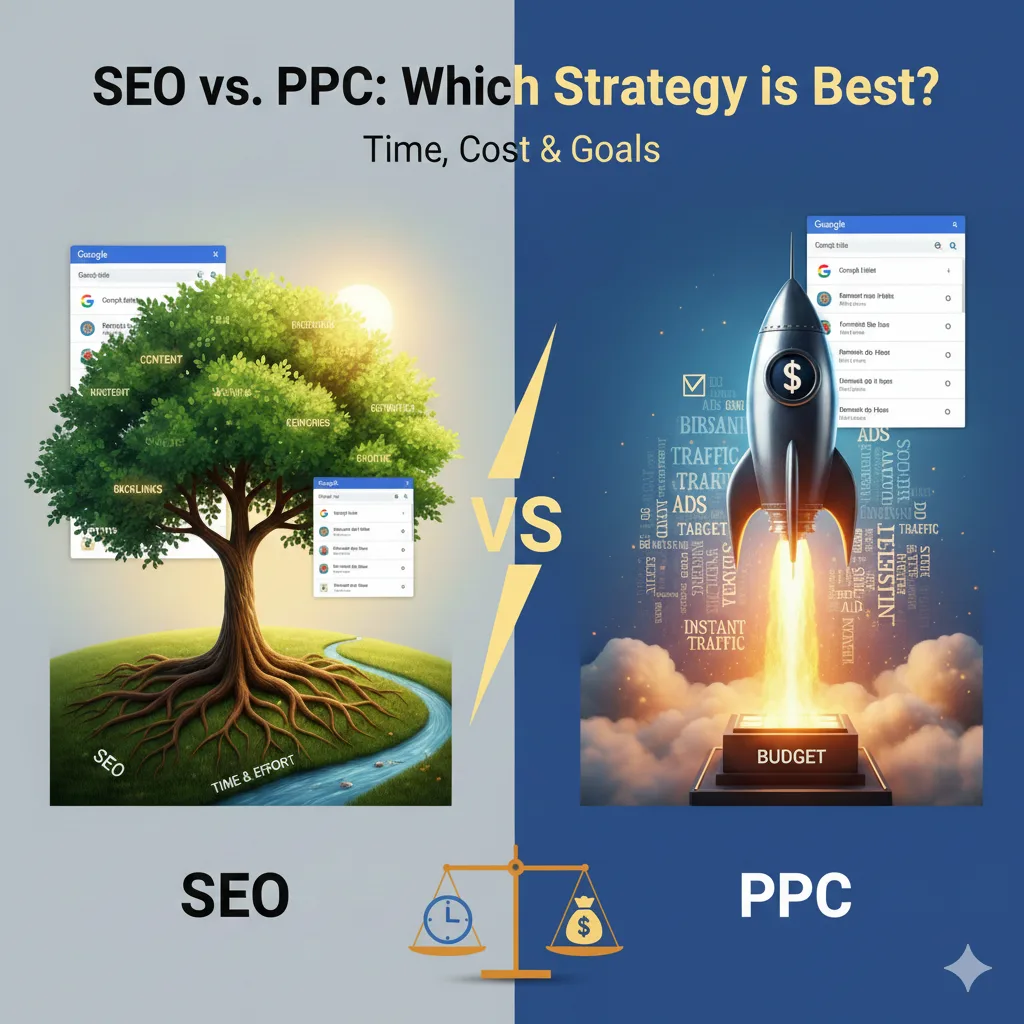
SEO is like planting a tree. It takes time to grow, but once it does, it keeps producing fruit. This makes it perfect for building long-term traffic.
Your Business is Local
If you run a local business—like a dental clinic, salon, or restaurant—local SEO can drive massive traffic. Optimize your Google Business Profile and target local keywords.
You Sell Evergreen Products or Services
If your offerings don’t change much and people always need them (like plumbing, legal services, or software), SEO will bring consistent, qualified leads.
You Have Time to Wait
Startups and businesses with runway can invest in SEO early. The results compound over time, giving you a competitive advantage.
When Should You Choose PPC?
PPC shines when you need results fast. Here are scenarios where paid ads make sense:
You Need Immediate Traffic
Launching a new product? Running a limited-time sale? PPC gets you in front of customers right now.
You’re Testing a New Market
Before investing months in SEO, use PPC to test if there’s demand for your product. You’ll get data quickly on what works.
You’re in a Highly Competitive Niche
If your competitors dominate organic rankings, breaking in with SEO could take years. PPC lets you compete immediately.
You Have a High-Value Product
If your average customer is worth $1,000 or more, spending $50-$100 to acquire them through PPC can be very profitable.
You Want Precise Targeting
PPC lets you target specific demographics, locations, and even remarket to people who visited your site. This precision is hard to match with SEO alone.
SEO + PPC Combined Strategy (The Winning Formula)
Here’s a secret: The best digital marketing strategy for business uses both SEO and PPC together.
This isn’t about doubling your budget. It’s about using each strategy where it’s strongest.
How to Combine Them Effectively
Start with PPC for quick wins. Launch paid campaigns to drive traffic while your SEO efforts build momentum.
Use PPC data to inform your SEO. See which keywords convert best in your ads? Target those with SEO content.
Dominate the search results. When you rank organically AND run ads, you take up more space on the page. This increases visibility and trust.
Remarket with PPC. Use ads to bring back visitors who found you through organic search but didn’t convert.
Scale what works. Once you know which products or messages perform, invest in SEO content around those topics.
Real Example
Imagine you sell handmade candles online. You start with Google Ads targeting “buy scented candles online.” You get sales and learn which scents are most popular.
Meanwhile, you create blog posts like “Best Scented Candles for Relaxation” and “How to Choose the Perfect Candle Gift.” These rank over time and bring free traffic.
Six months later, you’re getting sales from both paid ads and organic search. Your customer acquisition cost drops because SEO traffic is free.
Cost Comparison: What’s Budget-Friendly?
Let’s talk money. Small business owners need to know what they’re getting into.
SEO Costs
DIY approach: Free if you do it yourself, but requires learning and time.
Hiring help: An SEO consultant or agency might cost $500-$5,000/month depending on scope.
Tools: Expect to spend $100-$300/month on tools like Ahrefs, SEMrush, or Moz.
Content creation: Quality blog posts cost $100-$500 each if you outsource.
PPC Costs
Ad spend: This varies wildly. You could spend $500/month or $50,000/month depending on your industry.
Management: If you hire someone, add $500-$2,000/month for campaign management.
Cost per click: In some industries (like legal or insurance), clicks cost $50+. In others (like crafts), they might be $1-$2.
The Verdict
For tight budgets, SEO offers better long-term ROI. For businesses with cash flow and urgent goals, PPC delivers faster returns.
Most successful businesses invest in both, adjusting the mix as they grow.
Real-World Business Examples
Let’s look at how different businesses should approach this:
Example 1: Local Coffee Shop
Best strategy: Focus heavily on local SEO. Claim and optimize your Google Business Profile. Get reviews. Create content about “best coffee in [your city].”
Add PPC? Maybe a small budget during grand opening or special events.
Example 2: E-commerce Fashion Store
Best strategy: Use PPC to drive sales during peak seasons (holidays, Black Friday). Build SEO for product categories and style guides.
Why both? Fashion is competitive. PPC keeps cash flowing while SEO builds authority.
Example 3: B2B Software Company
Best strategy: Invest heavily in SEO with thought leadership content, case studies, and how-to guides.
Add PPC? Yes, for retargeting and capturing high-intent keywords like “best [software type] for [industry].”
Example 4: Emergency Services (Plumbing, Locksmith)
Best strategy: Split focus. Use local SEO to rank for “emergency plumber near me.” Run PPC ads 24/7 because people need these services urgently.
Why both? When someone’s toilet is flooding, they click the first result—paid or organic.
Common Mistakes to Avoid
Avoid these pitfalls when choosing between SEO and PPC:
Expecting SEO Results Too Soon
SEO is not a sprint. If someone promises first-page rankings in 30 days, run away. Real SEO takes 3-6 months minimum.
Ignoring Quality Score in PPC
Google rewards relevant, high-quality ads with lower costs. Don’t just throw money at ads—optimize your landing pages and ad copy.
Choosing One and Ignoring the Other
Unless you have serious constraints, you should use both strategies. They complement each other beautifully.
Not Tracking Results
Use Google Analytics and Google Search Console. Track which channels bring traffic, leads, and sales. Make decisions based on data, not guesses.
Keyword Stuffing in SEO
Don’t cram keywords unnaturally into every sentence. Write for humans first, search engines second.
Setting and Forgetting PPC Campaigns
PPC requires constant monitoring and optimization. Check your campaigns weekly at minimum.
Pro Tips to Increase Website Traffic
Want to maximize results from either strategy? Follow these tips:
For SEO Success
Create comprehensive content: Don’t write 300-word fluff. Aim for 1,500+ words of genuinely helpful information.
Target long-tail keywords: Instead of “shoes,” target “best running shoes for flat feet.” Less competition, more specific intent.
Optimize for featured snippets: Structure answers in list or table format to appear in position zero.
Build quality backlinks: Guest post on relevant blogs, get mentioned in local news, create shareable resources.
Improve site speed: A fast website ranks better and converts better.
For PPC Success
Use negative keywords: Exclude searches that waste money. If you sell premium products, exclude “cheap” or “free.”
Test everything: Run A/B tests on headlines, images, and calls-to-action.
Focus on quality score: Better quality scores mean lower costs per click.
Use ad extensions: Add site links, callouts, and structured snippets to make ads more clickable.
Remarket aggressively: Most people don’t buy on first visit. Bring them back with retargeting ads.
Final Verdict: Which is Best for Your Business Goals?
The difference between SEO and PPC comes down to your timeline, budget, and goals.
Choose SEO if: You want sustainable, long-term growth. You have patience. You want to build brand authority. You have a limited budget.
Choose PPC if: You need traffic now. You’re launching something new. You have budget to invest. You want precise targeting and control.
Choose both if: You want the best of both worlds. You can manage a split budget. You’re serious about dominating your market.
Here’s my recommendation: If you’re just starting out, begin with a small PPC campaign to generate immediate revenue and test your market. Simultaneously, start building your SEO foundation with quality content.
As your SEO gains traction, you can reduce PPC spend or use it strategically for promotions and retargeting.
Remember, the best marketing strategy for small business isn’t always the flashiest. It’s the one you can sustain and that aligns with how your customers find solutions.
Take the Next Step
Still unsure which strategy fits your business? You don’t have to figure this out alone.
A digital marketing consultant can analyze your specific situation, competitors, and goals. They’ll create a customized plan that maximizes your ROI—whether that’s SEO, PPC, or a smart combination of both.
Ready to grow your business? Schedule a free consultation with a digital marketing expert today. Get a custom strategy tailored to your budget and goals.
Don’t let your competitors take all the traffic. Start your journey to more visibility, more leads, and more sales today.
Frequently Asked Questions (FAQs)
Q: Is SEO better than Google Ads for small businesses?
It depends on your goals. SEO is better for long-term, sustainable growth with a limited budget. Google Ads (PPC) is better when you need immediate results or want to test a new market quickly. Many small businesses benefit from using both strategies together.
Q: How long does it take to see results from SEO?
Most businesses see initial results within 3-6 months. However, significant rankings and traffic typically take 6-12 months. SEO is a long-term investment that compounds over time, unlike PPC which stops when you stop paying.
Q: Can I do SEO and PPC at the same time?
Absolutely! In fact, using both strategies together often produces the best results. PPC provides immediate traffic while your SEO builds momentum. You can also use PPC data to identify which keywords work best, then target those with SEO content.
Q: What’s cheaper: SEO or PPC?
SEO has lower ongoing costs once you rank, making it cheaper long-term. PPC requires continuous ad spend but delivers immediate results. For most businesses, SEO offers better ROI over time, but PPC is more cost-effective for short-term campaigns.
Q: How much should I budget for PPC advertising?
Start with what you can afford to lose while testing. Many small businesses begin with $500-$1,000/month. Your budget depends on your industry’s cost-per-click and how many leads you need. Monitor your return on ad spend (ROAS) and adjust accordingly.
Q: Will PPC hurt my SEO rankings?
No. Running paid ads does not negatively impact your organic rankings. Google keeps paid and organic results separate. However, PPC can indirectly help SEO by driving traffic to your site and increasing brand searches.
Q: What if I can only afford one strategy?
If budget is extremely tight, start with SEO. Create quality content, optimize your Google Business Profile (for local businesses), and build basic on-page SEO. As you generate revenue, add PPC for targeted campaigns and faster growth.
Meta Description
SEO vs PPC: Discover which digital marketing strategy works best for your business goals. Compare costs, results, and learn when to use SEO, PPC, or both for maximum ROI.